
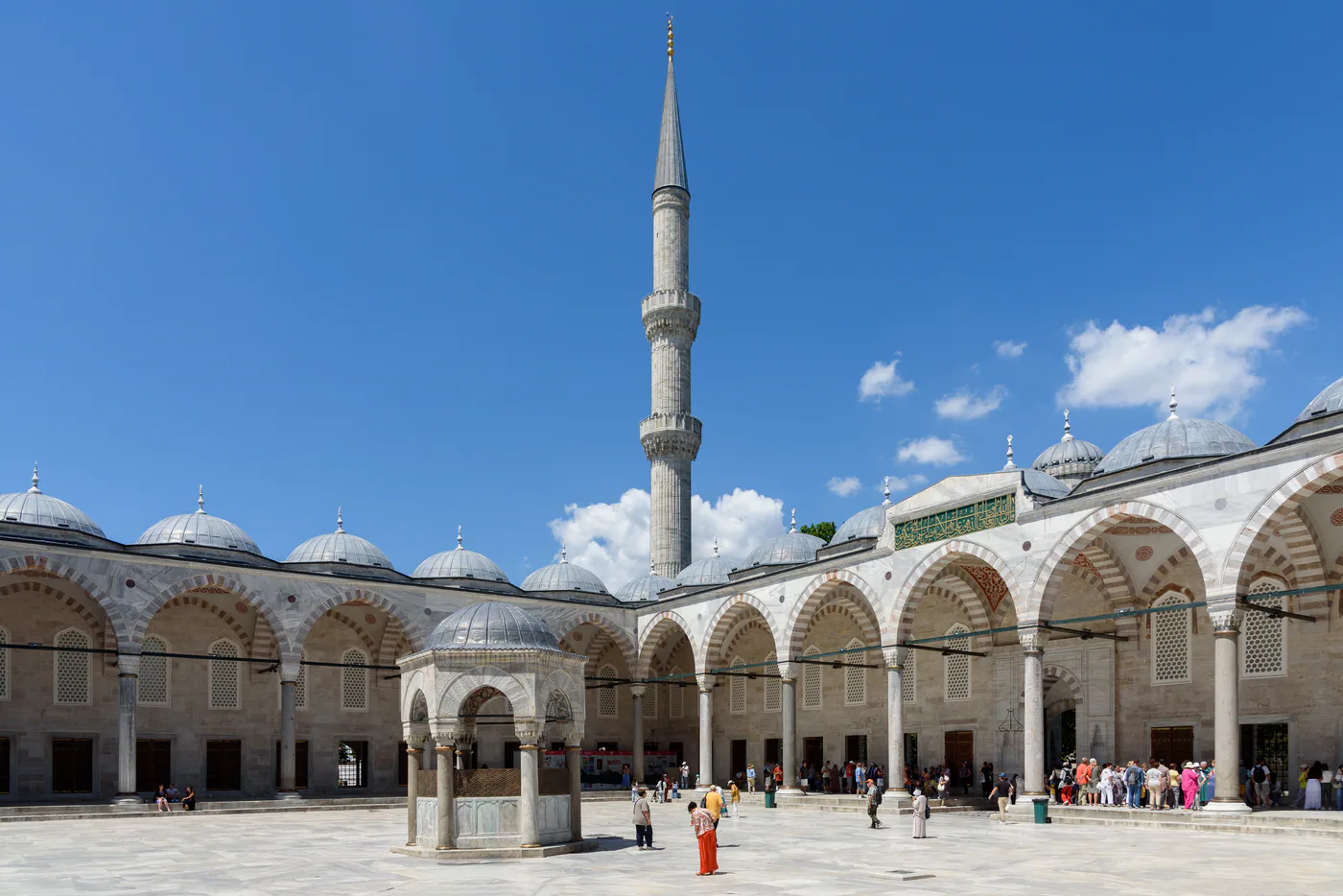
The Blue Mosque is both a landmark and a place where people come to pray. That is the simplest starting point for a good visit. Arrive with a flexible plan, dress appropriately and leave a little room in the day to return if sightseeing access pauses for worship.
Its Turkish name is Sultanahmet Camii. You will see that name on signs and maps, so save it before setting out. GoTürkiye’s mosque guide identifies the six minarets, domes and İznik tile decoration that give the building its familiar appearance and English name.
First the courtyard, then the interior
Do not walk straight through the courtyard while looking at your phone. It gives you space to understand the building before you enter: the arcades frame the open sky, and the repeated domes lead your eye toward the main prayer hall. Look back toward the entrance once you have moved out of the flow of arriving visitors.
Inside, allow your eyes to adjust before deciding where to look. The effect comes from the combination of coloured tilework, patterned surfaces, windows and the scale of the domes overhead. The mosque is not simply a blue-painted room. Look for smaller areas of decoration rather than trying to photograph the whole interior at once.
A short visit can be satisfying. Allow around 45 minutes for the courtyard and permitted interior areas, with more time if you enjoy architectural detail. Leave extra time for the queue.
A few courtesies make everything easier
Bring a scarf if you may need a head covering and choose clothes that cover shoulders and knees. Wear shoes that are easy to remove and follow the instructions at the entrance about carrying or storing them. Keep your belongings together so you do not hold up the doorway while sorting bags.
The prayer area is not a photo backdrop. Give worshippers space, avoid pointing a camera at people praying and keep your voice down. Follow any photography signs and the attendants’ directions, even if another visitor is doing something different. Parents can make the visit easier for children by explaining before entering why people are being quiet and taking off their shoes.
Prayer times vary through the year, so a fixed sightseeing timetable copied from an old itinerary is not a reliable plan. Friday midday is a particularly sensible time to leave flexibility. If the interior is unavailable, explore the square and come back; there is plenty nearby without buying another ticket immediately.
The best nearby stops
The former Hippodrome lies beside the mosque. Walk through it slowly and notice the monuments still standing along the old ceremonial space. It is a useful outdoor pause between interiors, and a chance to see the mosque from a different angle.
Across the square, Hagia Sophia offers a striking comparison in shape, light and history. The two buildings are close enough to combine easily, but their entrance arrangements are different. Do not assume a mosque visit and a paid gallery visit use the same rules or ticket.
For more decorative arts, the Turkish and Islamic Arts Museum occupies Ibrahim Pasha Palace on the western side of the Hippodrome. Its collections can turn details you noticed in the mosque into a fuller picture of craftsmanship. Or head toward the smaller streets and the Arasta Bazaar for a gentler break. Our Sultanahmet guide brings these stops together into a walk that leaves room for lunch and time outside.
Addresses & maps
Put it on your map
Sultanahmet Camii
At Meydanı Caddesi, SultanahmetFatih, Istanbul
Use the signed visitor entrance. Access for sightseeing follows the mosque's prayer arrangements.